By Heather Pirtle, Founder and President of FIRST-Network
The BOP just renamed one of its key divisions—and the new BOP Compliance and Oversight language may tell us far more than the announcement says on the surface.
On paper, that may not sound earth-shattering. But when I read the announcement, my immediate thought was: Why this name, and why now?
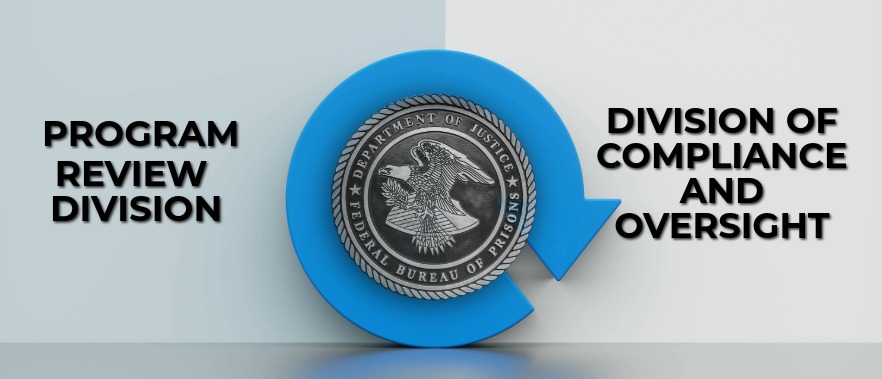
The former Program Review Division is now the Division of Compliance and Oversight. The Program Review Branch is now the Internal Auditing Branch.
Those are not softer names. They are stronger, more deliberate, and far more accountability-focused.
“Program review” sounds like someone checks how a program is working and makes recommendations.
“Compliance and oversight” sounds like someone checks whether people followed the rules—and documents what happens when they do not.
That difference caught my attention.
According to the BOP’s official announcement, the newly named division will act as the Bureau’s “internal watchdog.”
That is a powerful description.
So, is this merely a rebrand? Or is Director William K. Marshall III quietly building the structure he needs to create real accountability inside the BOP?
Now, let me be clear: I do not have inside information. But after years of hearing from families and incarcerated individuals, I have learned not to look only at what an announcement says. I also look at what it may allow the agency to do next—and at the patterns others may overlook.
This is where my mind went.
Why BOP Compliance and Oversight Matters
The new BOP Compliance and Oversight structure includes three main areas:
- Internal Auditing
- External Auditing
- Equal Employment Opportunity
The BOP organizational page now places Compliance and Oversight alongside its other Central Office divisions. The division’s page also emphasizes credibility, integrity, transparency, compliance, and proactive oversight.
To be clear, many of these responsibilities already existed. The former Program Review Division was not brand new.
Still, names tell us how leadership wants people to understand a department’s purpose.
The BOP did not rename it the “Program Improvement Division.” It chose Compliance and Oversight.
It did not call the branch “Quality Review.” It chose Internal Auditing.
Those choices matter.
An Audit Creates a Record
A review can result in a conversation, suggestion, or recommendation.
An audit creates evidence.
A real audit should determine:
- What policy required
- Whether leadership communicated that policy
- Whether employees received proper training
- Whether the institution followed the directive
- Who knew about any failure
- Whether leadership required corrective action
- Whether anyone followed up
- Whether the same problem happened again
In other words, an audit creates a paper trail.
That paper trail can show the difference between an honest mistake, inadequate training, a lack of resources, poor management, and intentional refusal to follow policy.
It can also show whether the institution corrected a problem—or allowed it to continue.
If I Were the BOP Director…
Imagine trying to change an agency as large and complicated as the BOP.
A director can issue a policy or directive. However, that does not mean every institution will carry it out consistently.
The BOP has facilities across the country. Each one has its own leadership, staff culture, history, habits, and long-standing ways of doing things.
Some employees will welcome change. Others may delay it, resist it, interpret it differently, or continue doing things the same way they always have.
That is not unique to the BOP. It happens inside large organizations everywhere.
However, Director Marshall cannot simply walk into an institution and fire everyone who refuses to follow a new direction.
Federal employees have workplace protections. Union agreements, labor procedures, personnel rules, and due-process requirements all come into play.
Those protections serve an important purpose. Good employees should not lose their jobs because a supervisor dislikes them, because they reported misconduct, or because they raised a legitimate concern.
At the same time, those procedures mean leadership must properly document repeated noncompliance, misconduct, poor performance, or failure to follow lawful instructions.
If I were the BOP Director and wanted to create meaningful change, I would need more than complaints and rumors.
I would need documentation.
I would need consistent standards.
I would need formal findings.
I would need corrective-action plans.
Most importantly, I would need follow-up showing whether the institution actually fixed the problem.
That is why this change makes sense to me.
Building the Evidence Before Taking Action
Suppose Director Marshall issues a national directive, but one or more institutions fail to carry it out.
Before leadership takes serious action, it needs answers.
Did the institution receive the directive?
Did local leadership clearly communicate it?
Did employees understand what the BOP expected?
Did they receive the necessary tools and training?
Did managers monitor implementation?
When auditors identified a problem, did leadership require a correction?
Did the same problem happen again after that correction?
Without documentation, someone can always claim confusion, inadequate training, mixed instructions, or a misunderstanding.
However, once BOP Compliance and Oversight documents the requirement, the deficiency, the response, and the follow-up, continued noncompliance becomes harder to dismiss as a mistake.
One failure may be an error.
The same failure after training, notice, corrective action, and follow-up begins to look like a pattern.
And patterns create the evidence leadership needs to act.
This Could Protect Good Employees, Too
Accountability should not mean targeting employees or assuming every mistake is intentional.
A legitimate auditing system should also protect good employees.
For example, an audit may show that an institution did not have enough staff, resources, training, or direction to satisfy a requirement.
Records may reveal that an employee repeatedly reported a dangerous problem while local leadership ignored it.
Documentation may show that employees received conflicting instructions from different levels of management.
In those situations, the evidence should support the employees who tried to do the right thing.
That is why the independence and integrity of BOP Compliance and Oversight will matter.
The division cannot become another tool that protects people at the top while blaming everyone below them.
Real accountability has to work in every direction.
Here Is the Part We Cannot Ignore
The BOP has never lacked policies.
It has never lacked forms, procedures, reviews, committees, or official statements.
Yet families and incarcerated individuals continue reporting many of the same problems:
- Inaccurate sentence calculations
- Inconsistent First Step Act implementation
- Delayed medical care
- Unsafe conditions
- Unanswered grievances
- Staffing shortages
- Retaliation concerns
- Policies interpreted differently from one institution to another
- Corrective actions that never seem to correct anything
The Department of Justice Office of the Inspector General has also identified serious weaknesses in BOP management, documentation, and oversight.
For example, a 2026 OIG audit examined the BOP’s documentation of compliance.
The warning signs are not new.
Therefore, the real question is not whether the BOP can identify problems. The real question is what happens after it identifies them.
Does anyone require corrective action?
Does anyone verify that the correction occurred?
What happens if an institution continues doing the same thing?
Does Central Office compare problems across multiple facilities, or does it continue treating every complaint as an isolated incident?
That is where the success or failure of BOP Compliance and Oversight will become clear.
What I Will Be Watching
If this is part of a larger strategy, we may begin seeing several signs.
First, the BOP may place more emphasis on written directives and measurable compliance.
Next, institutions may receive more formal findings and corrective-action requirements.
Then, auditors may return to determine whether local leadership actually fixed the problem.
We may also see Central Office compare findings across institutions instead of viewing each failure in isolation.
Finally, repeated findings could support management changes, personnel actions, new training, policy revisions, or other operational decisions.
That would create a logical process:
Set the standard. Communicate it. Audit performance. Document failures. Require corrections. Follow up. Then act on the evidence.
Honestly, if I were trying to make changes inside the BOP while navigating federal employment rules, labor agreements, internal resistance, and layers of bureaucracy, this is exactly the type of system I would want to build.
Again, this is my observation—not inside information.
But the strategy makes sense.
FIRST-Network Can Help Connect the Dots
This is also where FIRST-Network can help.
We have built a platform that can capture concerns reported by incarcerated individuals, staff members, family members, advocates, and others in real time.
People can report an issue through FIRST-Network. We organize those reports so we can begin identifying patterns across institutions.
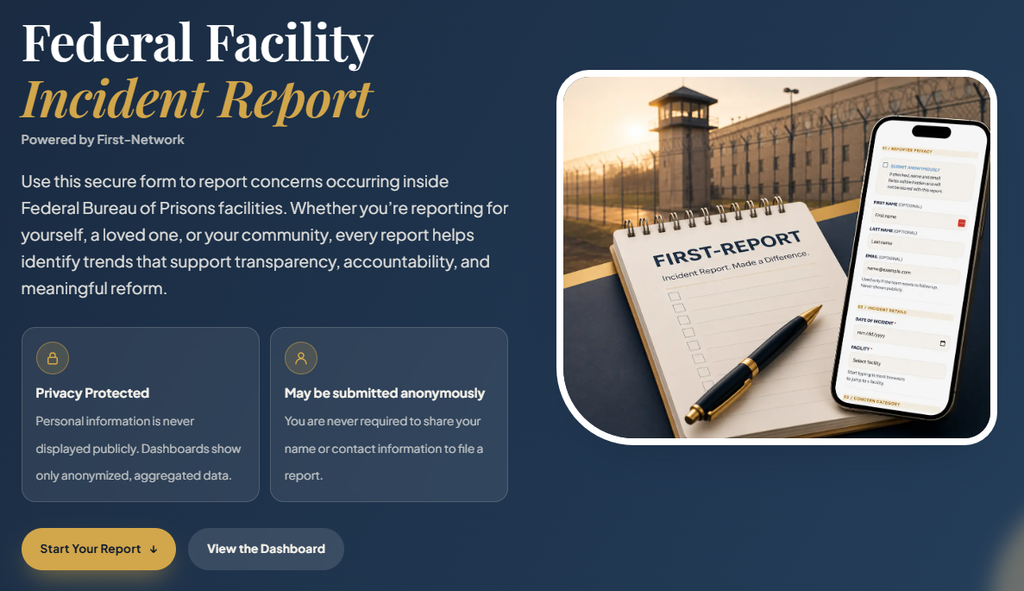
Our public FIRST-Network Reports Dashboard provides a broader view of the concerns people report from BOP facilities.
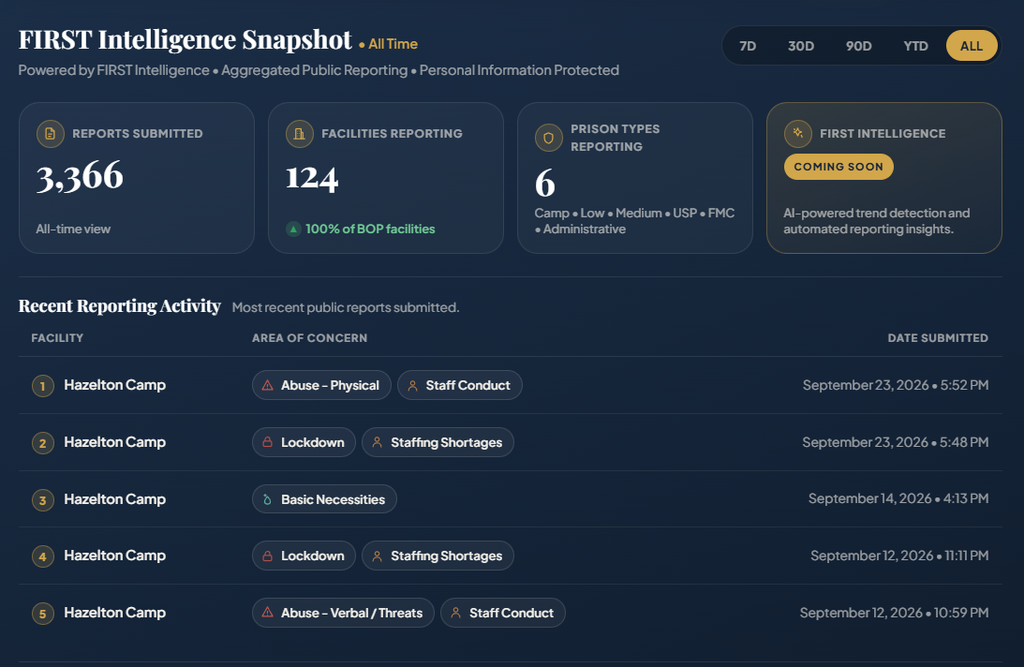
One report may appear to be an isolated complaint.
Ten similar reports from one institution may reveal a local pattern.
The same issue reported at several institutions may point to a national policy or implementation problem.
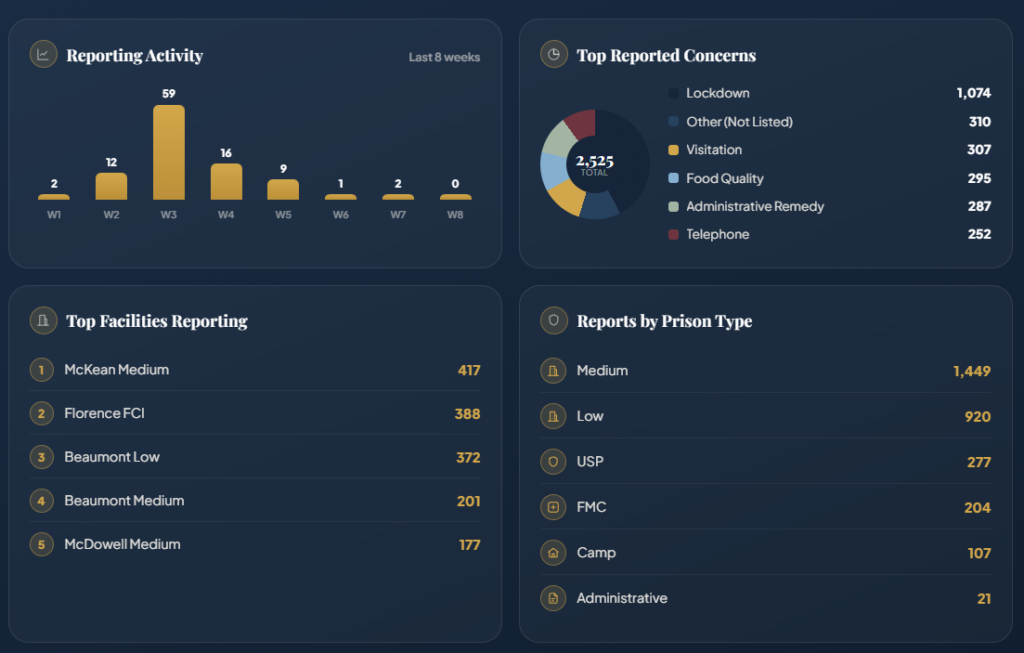
That information could help BOP Compliance and Oversight determine where to ask questions, where to audit, and where follow-up may be necessary.
Director Marshall, the DOJ and Congress – our door is open.
FIRST-Network has spent years building relationships with incarcerated individuals, families, advocates, and others who experience the effects of BOP decisions every day.
We are not interested in creating conflict simply for the sake of conflict.
We want accurate information, practical solutions, accountability, and better outcomes for everyone—including the good employees who are also trying to do the right thing within a system that clearly needs improvement.
If the BOP genuinely wants real-time information from outside its usual reporting channels, we are ready to help. We did not wait for every part of the Federal Prison Oversight Act to be fully implemented – or for a federal reporting system and Ombudsman’s office to become operational. We built a real-time reporting platform ourselves.
My Bottom Line
I am not ready to celebrate a name change before we see results.
However, I am also not willing to overlook what this change could mean.
Renaming “Program Review” as BOP Compliance and Oversight may only be a rebrand.
Or Director Marshall may be building the documentation and auditing system he needs to identify resistance, prove patterns, require corrections, and create accountability inside an agency where change has historically moved painfully slowly.
Now we watch what happens next.
Do audits become more transparent?
Does follow-up improve?
Do institutions correct repeated problems?
Does Central Office begin connecting the dots?
Do the same problems continue without consequences?
The answers will tell us whether this was simply a new name—or the beginning of a much larger strategy.
FIRST-Network has never been afraid to look closer, ask uncomfortable questions and discuss the things other people may overlook.
This is only my interpretation of what may be happening behind the scenes. Still, if I were the BOP Director, this approach would make complete sense to me.
What do you think?
Is this simply a name change, or is Director Marshall building the accountability system he needs to make larger changes?
Reality → Documentation → Data → Evidence → Action → Change
#BeTheirVoice
—Heather Pirtle
Founder and President, FIRST-Network
www.first-network.org
See a concern like this?
Document a facility issue in two minutes. Anonymous options available.