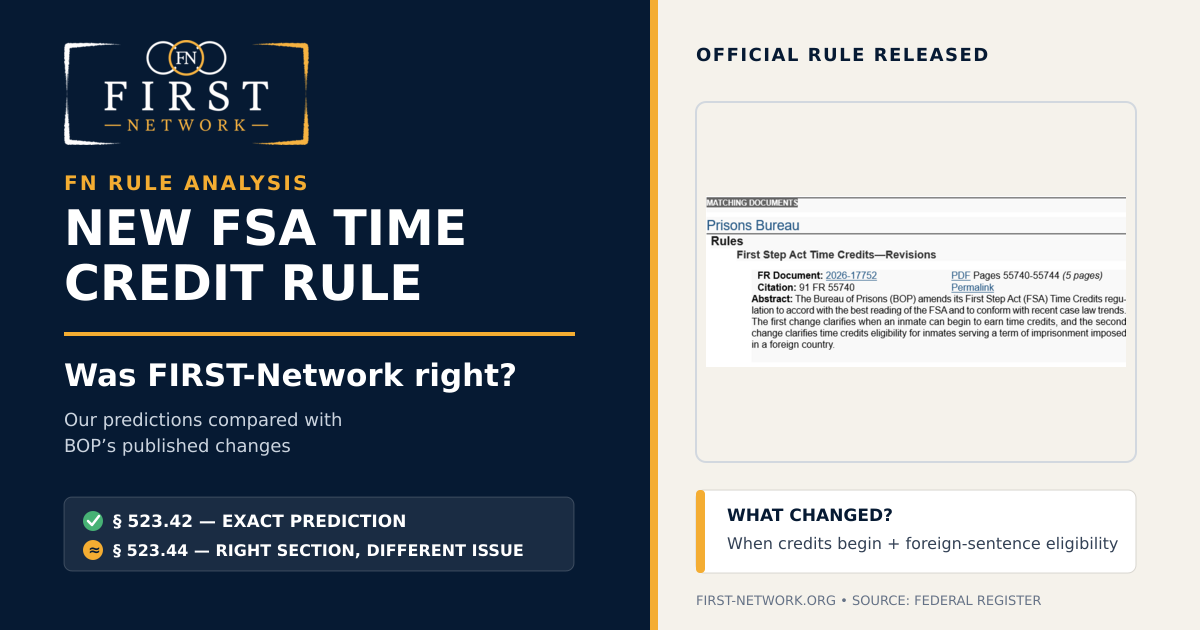
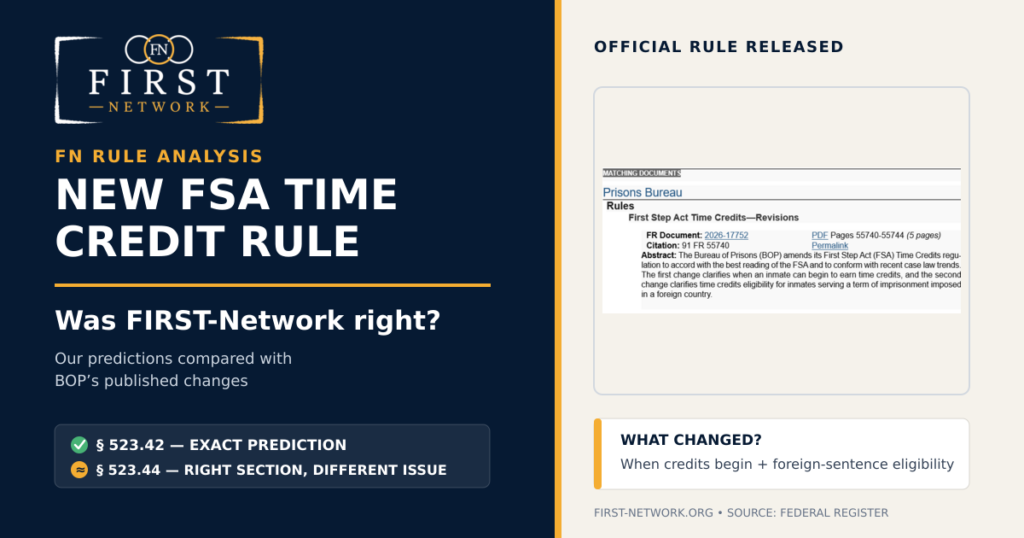
The new FSA Time Credit rule is finally here… so, was FIRST-Network right?
The short answer is YES – we correctly predicted 1 of the 2 actual changes. We also correctly identified the regulation section BOP would revise for the second change, but BOP addressed a different issue within that section.
And we are perfectly okay saying exactly where we were right, where we were only partially right & what we did not predict. That is the entire purpose of doing real research rather than simply repeating rumors circulating online.
How We Got Here
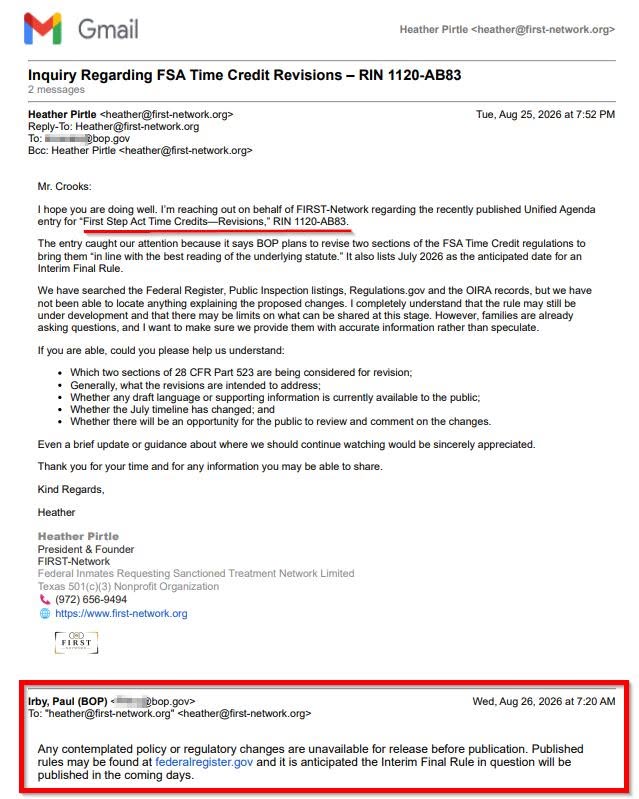
We reviewed the official Unified Agenda entry, then searched the Federal Register, Public Inspection listings, Regulations.gov & OIRA records. Although the Unified Agenda confirmed that BOP planned to revise two sections of its FSA Time Credit regulations, the actual sections and proposed language were not yet publicly available.
So… instead of stopping there or simply guessing, FIRST-Network reached out directly to BOP and asked for clarification.
BOP responded and explained that the actual regulatory changes could not yet be released, but confirmed that the Interim Final Rule was expected to be published “in the coming days.”
With the language still unavailable, we reviewed the existing regulations, the First Step Act, recent court decisions, BOP directives & the implementation problems families have been reporting. We then clearly labeled our analysis as informed speculation and shared what we believed were the two strongest possibilities.
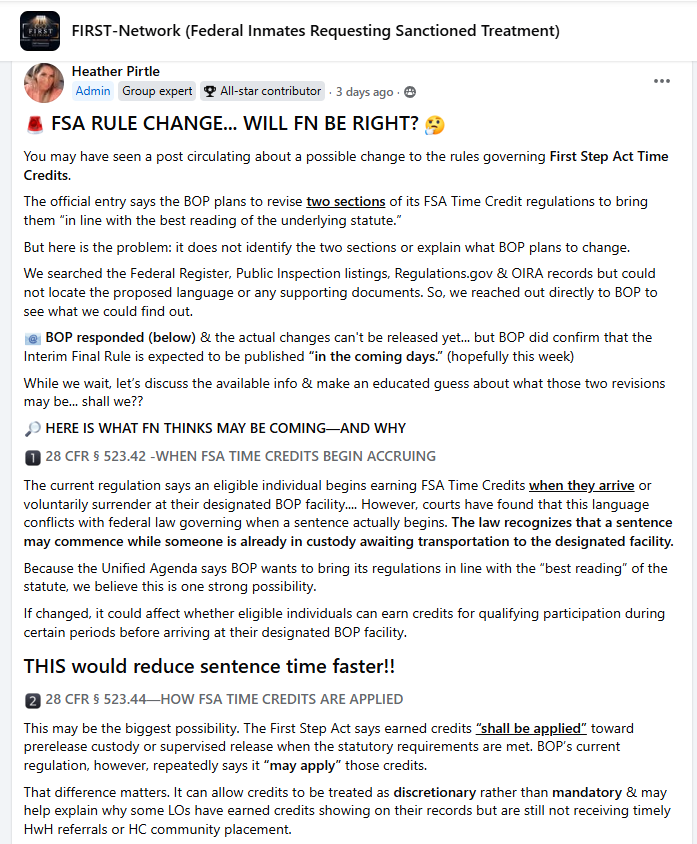
Now that the actual rule has been released, we can compare our predictions with what BOP really changed.
FN Prediction #1: When FSA Time Credits Begin Accruing
What FIRST-Network Predicted
We believed BOP would revise 28 CFR § 523.42, which governed when an eligible individual could begin earning FSA Time Credits.
The old regulation said an eligible person began earning credits when they arrived or voluntarily surrendered at the designated BOP facility where the sentence would be served.
That language created a major problem for people who were already serving their federal sentences but remained in custody awaiting transportation. Some spent weeks—or even months—in a detention center, local jail or other USMS-contracted facility before reaching their designated BOP institution.
Recent courts had concluded that BOP’s arrival requirement added a restriction that was not found in the First Step Act and conflicted with the law governing when a federal sentence begins.
For that reason, FN predicted that BOP would remove the designated-facility arrival requirement and allow eligible individuals to begin earning after their federal term of imprisonment commenced.
What BOP Actually Changed
That is exactly what BOP did. 🎯
The revised regulation now states:
“An eligible inmate begins earning FSA Time Credits after the inmate’s term of imprisonment commences.”
BOP removed the language tying the beginning of FSA Time Credit accrual to arrival or voluntary surrender at the designated BOP facility.
Under the new rule, the relevant starting point is when the federal term of imprisonment commences. BOP explains that this may occur when a person is received into federal custody after sentencing while awaiting transportation—or when someone voluntarily surrenders to begin serving the sentence.
Why This Change Matters
BOP reviewed sentences beginning from 2023 through 2025 and found that the average time between sentencing and arrival at the designated facility was 66.06 days.
Based on BOP’s analysis of the population’s risk levels, that period could result in an average of approximately 23.81 additional days of FSA Time Credits.
Those additional credits could allow eligible individuals to reach prerelease custody or supervised release sooner. Depending on the person’s eligibility, risk level, sentence & amount of earned credits, that may mean earlier transfer to:
- A Residential Reentry Center or halfway house
- Home confinement
- Supervised release
BOP estimates that thousands of eligible individuals may benefit and projects approximately $54.1 million in annual savings from earlier transfers or releases.
So yes… this change could reduce time in a secure BOP facility for many eligible individuals.
Important: The Credits Are Not Automatic
The new FSA Time Credit rule changes when an eligible person may begin earning. It does not award credits automatically for every day spent awaiting transportation.
The individual must still successfully complete qualifying Evidence-Based Recidivism Reduction programs or Productive Activities assigned based on assessed needs.
This raises an important practical question:
How will qualifying participation be assigned, offered, documented & credited while someone is in transit or housed in a non-BOP facility?
BOP says the change allows individuals awaiting transportation to begin FSA-approved programming. However, families will need to watch how this works in practice, particularly when a person is being held in a local or regional jail with limited access to BOP programming.
The regulatory change is positive. The implementation will determine how much of that benefit individuals actually receive.
Could This Affect Your LO?
This change may be relevant if your loved one:
- Was eligible to earn FSA Time Credits;
- Was remanded into federal custody after sentencing;
- Waited days, weeks or months to reach the designated BOP facility; and
- Participated in qualifying programming or Productive Activities during that period.
Families should compare the date the federal sentence commenced with the date used on the current FSA Time Credit calculation. However, how BOP will document and credit qualifying participation during transportation or placement in a non-BOP facility remains an important implementation question.
FN Prediction #2: How FSA Time Credits Are Applied
What FIRST-Network Predicted
Our second prediction also involved the correct regulation section: 28 CFR § 523.44.
We believed BOP might address the difference between the First Step Act’s direction that earned credits “shall be applied” when the statutory requirements are met and regulatory language stating that BOP “may apply” those credits.
That distinction matters because families continue reporting individuals who have substantial earned credits on their records but are not receiving timely halfway-house referrals, home-confinement placement or application toward supervised release.
We believed BOP might formally strengthen or clarify the mandatory application of eligible credits, particularly in light of Director Marshall’s directives concerning FSA and Second Chance Act stacking, Conditional Placement Dates, direct home confinement & timely prerelease referrals.
What BOP Actually Changed
We correctly identified § 523.44 as the second section being revised—but BOP addressed a different issue within that section.
The actual amendment concerns certain individuals who:
- Were convicted and sentenced in a foreign country;
- Are U.S. citizens or nationals transferred into BOP custody under an applicable treaty; and
- Have an equivalent U.S. Code sentence determined by the U.S. Parole Commission under 18 U.S.C. § 4106A.
The revised regulation clarifies that § 523.44(a)(3) does not bar FSA Time Credits from being applied for those individuals solely because their original conviction was imposed under foreign law.
BOP states that this amendment codifies its current practice and gives qualifying treaty-transfer individuals access to the same risk-reduction incentives and reentry resources available to other eligible individuals.
This is a meaningful correction for the people it affects—but it is a much narrower group than the broader population involved in our prediction.
What the New Rule Does Not Fix
The new rule does not address the “may apply” versus “shall be applied” concern raised in our original analysis.
It also does not directly resolve the ongoing reports involving:
- Earned credits appearing on records but not being timely applied
- Delayed prerelease referrals
- FSA and Second Chance Act placement periods not being properly stacked
- Conditional Placement Dates not guiding timely action
- Individuals appropriate for direct home confinement remaining in institutions or halfway houses
- Confusion among case managers, Residential Reentry Management offices & halfway houses about current placement calculations
Those implementation concerns remain—and FIRST-Network will continue documenting them.
The Honest FN Scorecard
Here is the most accurate way to describe our predictions:
- Prediction #1: Correct regulation section & correct substantive change. FN was right.
- Prediction #2: Correct regulation section, but BOP revised a different issue within that section.
In other words, we correctly predicted 1 of the 2 actual changes and partially identified the structure of the second.
Considering that the proposed language was unavailable when we conducted our analysis, I would say we did pretty darn good. LOL.
More importantly, we showed our work. We explained that our original post was informed speculation, identified the evidence supporting our conclusions & promised to return once the actual language became available.
That is exactly what we are doing now.
When Does the New FSA Time Credit Rule Take Effect?
The Interim Final Rule is scheduled for publication in the Federal Register on August 31, 2026.
The rule becomes effective on September 30, 2026. Written and electronic public comments are also due by September 30, 2026.
The complete rule and instructions for submitting comments are available through the Federal Register:
Read the complete FSA Time Credit rule
What Families Should Watch Next
The regulatory language is only the first step. We now need to watch how BOP puts it into practice.
Important questions include:
- When will BOP update its calculation system?
- Will current eligible individuals receive recalculations automatically?
- How will qualifying activities completed while awaiting transportation be verified?
- What documentation should individuals request if earlier qualifying participation is missing?
- Will updated credits change current Conditional Placement Dates, halfway-house referrals, home-confinement eligibility dates or supervised-release dates?
- What process will families and incarcerated individuals use when the calculation is not corrected?
FIRST-Network will continue reviewing BOP guidance, monitoring updated calculations & collecting reports from individuals and families as implementation begins.
If your loved one’s calculation changes—or should change but does not—please document the dates, request an updated FSA Time Credit calculation & keep copies of any relevant records.
This article is provided for educational and informational purposes and is not legal advice. Individual eligibility and credit calculations depend on each person’s circumstances and BOP records.
Stay Connected With FIRST-Network
FIRST-Network provides education, resources, real-time reporting & community support for individuals and families navigating the federal prison system.
We discuss FSA Time Credits, Second Chance Act placement, halfway houses, home confinement, BOP policies, reentry & much more in our Facebook community.
Join the FIRST-Network Facebook Group
If your loved one is experiencing a concern at a federal prison, you can submit a report. These reports help us identify patterns across BOP facilities and better understand how policies are being implemented in real life.
Report a Federal Prison Concern
You can also view the FIRST-Network Dashboard to explore reported concerns, facility information & developing trends.
View the FIRST-Network Dashboard
Visit FIRST-Network.org to learn more about our mission, resources & advocacy efforts.
The rule has been written… now we need to make sure the benefit reaches the people it was intended to help.
FIRST-Network | #BeTheirVoice
Reality → Documentation → Data → Evidence → Action → Change
See a concern like this?
Document a facility issue in two minutes. Anonymous options available.